

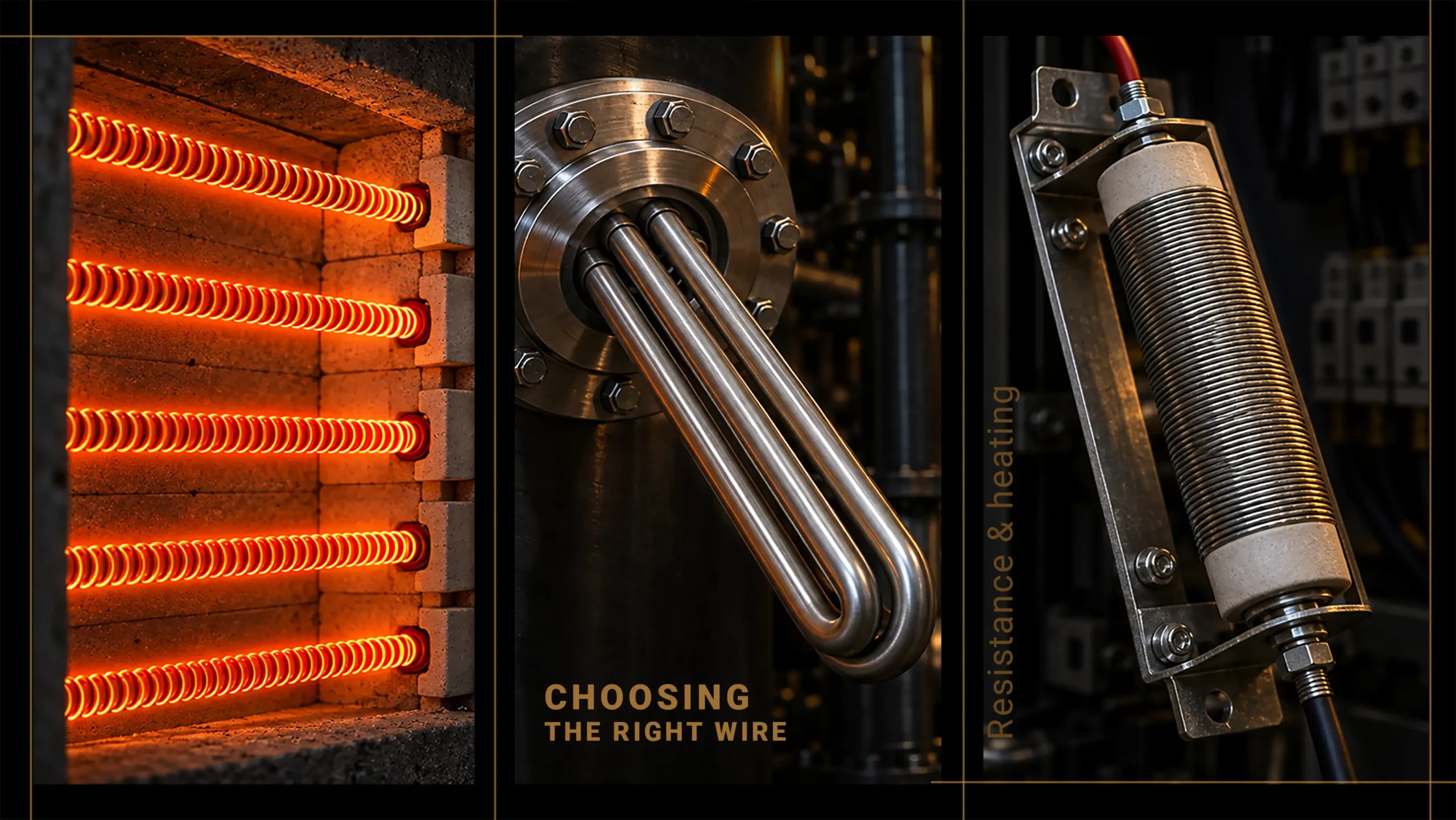


Choosing between nickel-chrome (NiCr), iron-chrome-aluminium (FeCrAl) and copper-nickel (CuNi) resistance wire starts with understanding the application. NiCr and FeCrAl are commonly compared for high-temperature heating, while selected CuNi grades are useful where controlled electrical resistance and lower-temperature operation take priority. Their electrical, thermal and mechanical properties differ, so they should not be treated as interchangeable materials.
At NOCKERS ENGINEERING PRODUCTS, we supply resistance and heating wire to customers’ specified requirements. Our range includes all three alloy families for use by manufacturers of industrial heaters, wire-wound resistors and other resistance-wire components.
In this guide, we compare the material characteristics that matter when purchasing resistance wire: resistivity, temperature capability, oxidation behaviour, mechanical properties, application suitability and indicative price.
For the FeCrAl comparison, we use Kanthal® D as the published manufacturer benchmark because we stock a D-equivalent material. The information supports material comparison and specification discussions; it is not a substitute for the design and validation of the finished component.
NiCr vs FeCrAl vs CuNi at a Glance
Each alloy family contains grades with different properties. To make the comparison meaningful, the table uses three specific manufacturer benchmarks: Nikrothal® 80 for Ni80Cr20, Kanthal® D for FeCrAl, and Cuprothal® 49 for CuNi44.
The temperature figures are published maximum continuous operating temperatures in air. They are not guaranteed furnace temperatures or suitable operating temperatures for every wire diameter, element arrangement or atmosphere.
| Comparison factor | NiCr — Ni80Cr20 benchmark: Nikrothal® 80 | FeCrAl — benchmark: Kanthal® D | CuNi — CuNi44 benchmark: Cuprothal® 49 |
|---|---|---|---|
| Alloy family | Nickel-chromium | Iron-chromium-aluminium | Copper-nickel |
| Electrical resistivity at 20°C | Approximately 1.09 Ω·mm²/m | Approximately 1.35 Ω·mm²/m | Approximately 0.49 Ω·mm²/m |
| Maximum continuous operating temperature in air | Up to 1,200°C | Up to 1,300°C | Up to 600°C |
| Oxidation or corrosion behaviour | Good oxidation resistance for elevated-temperature heating | Good oxidation resistance for high-temperature heating | Good corrosion resistance within its lower service-temperature range |
| Mechanical characteristics | Good ductility after use, weldability and useful hot-state mechanical properties | Mechanical behaviour differs from NiCr; wire size, operating temperature and support conditions matter | High ductility; electrical resistance characteristics are often the main selection priority |
| Typical applications | Furnace elements, tubular and cartridge elements, heaters and resistance components | Furnace elements, air heaters, selected tubular and cartridge elements, and heating cables | Rheostats, motor starter resistances, potentiometers and selected heating duties |
| Main comparison advantage | Balance of resistance-heating capability and mechanical performance | Higher resistivity and temperature rating than the Ni80Cr20 benchmark | Lower resistivity and relatively stable resistance for suitable controlled-resistance applications |
| Indicative relative material price | High | Low | Medium |
The technical values apply to the named benchmark products. The specification and material certificate for the wire actually supplied remain the basis for confirming its properties.
Price qualification: The High / Low / Medium comparison reflects our indicative positioning for the materials discussed, not a fixed market price or a universal ranking for every order. Grade, dimensions, quantity and market conditions affect the quotation. Material price alone does not establish the service life or operating cost of the finished component.
Trademark clarification: Kanthal®, Nikrothal® and Cuprothal® are registered manufacturer trademarks, referenced here to identify published technical benchmarks. They are not NOCKERS ENGINEERING PRODUCTS product brands. Referencing a benchmark does not mean that an equivalent wire is manufactured or branded by that trademark owner.
FeCrAl qualification: Kanthal® D is the FeCrAl benchmark throughout this article. Its properties must not be applied universally to every FeCrAl grade. The required grade, dimensions, operating conditions and supplied-material documentation must be confirmed before a material substitution is approved.
How We Compare the Alloy Families in Detail
NiCr: A Versatile High-Temperature Heating Alloy
Nickel-chrome alloys combine useful electrical resistivity with oxidation resistance and mechanical characteristics suitable for many resistance-heating applications. Within the family, the exact grade affects electrical behaviour, temperature capability and suitability for forming or fabrication.
The Ni80Cr20 benchmark used here, Nikrothal® 80, is associated with good form stability, ductility after use and weldability. Its published applications include industrial furnace elements, metal-sheathed tubular elements and cartridge elements.
Lower-nickel NiCrFe materials offer a different balance of composition and performance. For example, the Nikrothal® 60 benchmark has a published resistivity of approximately 1.11 Ω·mm²/m at 20°C and a maximum continuous operating temperature in air of 1,150°C. Its applications include tubular elements and suspended heating coils.
The commercial designation Ni60Cr15 should not be treated as an exact ASTM composition statement. ASTM B344 includes a nominal 60% nickel, 16% chromium, balance iron alloy family for electrical heating. The order specification should identify the required material and standard rather than rely on the shorthand name alone.
For a more detailed explanation of nickel-chrome grades, resistance, dimensions and material forms, see our Nichrome Wire Guide: Grades, Resistance, Sizes and Applications.
FeCrAl: Higher Resistivity and a Higher Temperature Benchmark
We use Kanthal® D as the FeCrAl reference because it is relevant to our standard D-equivalent stock, identified in our stock terminology as 0Cr23Al5. That commercial description should be checked against the specification and certificate for the material supplied, rather than assumed to establish complete interchangeability with the branded benchmark.
Compared with the Ni80Cr20 benchmark, Kanthal® D has higher electrical resistivity and lower density. These differences affect the resistance and weight of wire with a given length and cross-sectional area. They do not establish that FeCrAl will outperform NiCr in every finished component.
The mechanical figures also need to relate specifically to D. For 1.00 mm wire, the manufacturer lists 23% elongation for Kanthal® D, compared with 30% for Nikrothal® 80. These are published properties for the stated wire sizes—not measurements of ductility after prolonged high-temperature service.
NiCr’s hot-state mechanical behaviour and the support requirements of a FeCrAl element remain separate considerations. A higher temperature rating should therefore be assessed alongside the component’s mechanical demands, not used as the sole reason to change material.
CuNi: Controlled Resistance for Lower-Temperature Applications
Copper-nickel resistance alloys occupy a different operating range from the high-temperature NiCr and FeCrAl examples. Selected grades are relevant where resistance stability, ductility and the required electrical value matter more than the highest possible element temperature.
The CuNi44 benchmark used here, Cuprothal® 49, is associated with temperature-stable potentiometers, industrial rheostats, electric motor starter resistances and selected heating applications. Its electrical properties make it useful for certain controlled-resistance duties.
However, CuNi44 is not a universal 600°C material specification. The figure in the comparison table belongs to the named Cuprothal® 49 product. Other manufacturers publish different limits for their CuNi44 products, so the permitted temperature must be confirmed for the actual material supplied.
A low temperature coefficient of resistance means that resistance changes relatively little over a stated temperature interval. It does not mean that resistance is completely constant, nor that every CuNi grade has the same behaviour.
Low temperature coefficient also does not, by itself, establish suitability for every precision resistor. Thermal electromotive force at connections, long-term stability and the required tolerance may be equally important. These properties need to be specified together.
How the Comparison Changes by Application
Industrial Furnaces
For high-temperature furnace wire, NiCr and FeCrAl are generally the relevant starting comparison. The choice depends on more than which material has the higher published temperature rating.
A suitable FeCrAl grade may offer useful resistivity, oxidation resistance and material-weight advantages. NiCr may be important where hot mechanical strength, ductility or fabrication requirements influence the component specification. Neither removes the need to assess the actual operating atmosphere and element construction.
Furnace temperature and element temperature are not the same. While delivering heat, the resistance wire normally operates hotter than the surrounding chamber or load. Surface loading, heat dissipation and neighbouring elements influence the wire temperature.
A furnace operating below an alloy’s published maximum temperature is therefore not, by itself, proof that the wire is suitable. The responsible designer must establish the expected element temperature and the appropriate operating conditions.
Industrial Heaters
Both NiCr and FeCrAl are used in industrial heating equipment. Suitability depends on how the wire is incorporated into the finished component, including its support, insulation, heat transfer and mechanical loading.
Tubular and cartridge heaters should not automatically be treated as NiCr-only applications. Manufacturer guidance includes suitable NiCr and Kanthal® D materials for particular tubular and cartridge constructions. The component manufacturer’s specification determines which is appropriate for the particular assembly.
CuNi may be relevant to selected lower-temperature heating duties where its electrical characteristics meet the application requirements. Its indicative price position does not make it a substitute for either high-temperature alloy family.
Wire-Wound Resistors
A resistor generates heat during operation, but that does not mean its wire should be selected in the same way as an industrial furnace element.
For wire-wound resistance units, the specification may prioritise resistance value, tolerance, temperature coefficient, long-term stability and thermal electromotive force. Power resistors and precision resistance units can also have different requirements.
ASTM B267 addresses wire and ribbon with controlled electrical properties for wire-wound resistance units and similar applications. It explicitly excludes electrical heating elements. This is why a general request for “resistance wire” needs to be accompanied by the intended use and electrical requirements.
NiCr, CuNi and other resistance alloys may be appropriate for different resistor duties. FeCrAl should not be dismissed from all resistance applications either: ASTM B603 covers iron-chromium-aluminium shapes for electrical heating and resistance purposes. A high temperature rating alone, however, does not establish precision-resistor suitability.
We can source selected copper-nickel and nickel-chrome wire for trial and production requirements, including resistance tolerances down to approximately ±1% for suitable products. Availability and tolerance must be confirmed for the actual material and order. This is a wire-supply tolerance, not a guarantee of the finished resistor’s accuracy.
Why Changing Alloys Is Not a Direct Substitution
Electrical resistivity is a material property. Electrical resistance also depends on the conductor’s length and cross-sectional area.
For a uniform conductor:
R = ρL ÷ A
Here, R is resistance, ρ is resistivity, L is length and A is cross-sectional area.
For the same length and cross-section, resistance changes in proportion to resistivity. Using the published benchmark figures of 1.35 Ω·mm²/m and 1.09 Ω·mm²/m, Kanthal® D would have approximately 24% higher resistance at 20°C than the Ni80Cr20 benchmark. This is a calculated comparison, not a recommendation to substitute materials.
Wire diameter matters too. For the same alloy, temperature and length, doubling the diameter gives four times the cross-sectional area and reduces resistance to one quarter.
The finished component must also account for hot resistance, surface loading, expansion and support conditions. Surface loading describes power in relation to the relevant heated surface area; a wire with the required cold resistance may still operate at an unsuitable temperature if its geometry or heat-transfer conditions are wrong.
Any substitution should therefore be reviewed and approved by the customer’s responsible engineer or component manufacturer. We supply wire against the resulting agreed specification.
Practical Material Comparison Guide
| Application or Product | Materials to compare | What application or product designer must consider to select best suited material |
|---|---|---|
| High-temperature industrial furnace | Appropriate NiCr and FeCrAl grades | Actual element temperature, atmosphere, dimensions, supports and duty cycle |
| Tubular or cartridge heater | Suitable NiCr or FeCrAl, including D-equivalent material where specified | Component construction, insulation, sheath conditions and electrical requirements |
| Open-coil air heater | NiCr or FeCrAl | Coil geometry, airflow, support, loading and wire temperature |
| Rheostat or motor starter resistance | CuNi or another specified resistance alloy | Resistance, temperature coefficient, tolerance and operating temperature |
| Precision wire-wound resistance unit | A controlled-resistance grade meeting the specification | Stability, thermal electromotive force, tolerance and applicable standard |
| Higher resistance with unchanged wire dimensions | Compare the specific grades’ resistivities | The resulting cold and hot resistance; a different alloy is not an automatic replacement |
| Replacement wire for an existing component | The original specified grade or an approved alternative | Grade, dimensions, failure cause and approval of any substitution |
| New development or trial production | The alloy specified following the customer’s technical evaluation | Required properties, trial quantity, test criteria and production supply format |
The table provides material-comparison starting points rather than design instructions. The different heating-element configurations and controlled-resistance requirements must be assessed against the intended component.
We supply wire to the agreed material requirements. Design, manufacture and validation of the heating element or other finished component remain with the customer’s responsible technical team or component manufacturer.
Common Mistakes When Comparing Resistance Alloys
Applying One Grade’s Properties to an Entire Alloy Family
NiCr, FeCrAl and CuNi each contain multiple grades. A temperature rating or resistivity associated with one named product cannot be assumed to describe every material in its family.
The same caution applies to commercially equivalent materials. The actual specification and supplied-material documentation must be checked rather than relying on a comparison name alone.
Comparing Temperature Without Considering the Atmosphere
A published rating in air does not establish the same performance in a reducing, carburising, sulphurous or otherwise contaminated environment.
Furnace contaminants, including deposits and process vapours, can affect element life. The atmosphere must be part of the customer’s specification and technical assessment.
Choosing on Material Price Alone
Our indicative High / Low / Medium comparison is useful for initial purchasing discussions, but it does not replace a quotation or a finished-component cost assessment.
The lowest material price may not provide the best overall result where different processing, component geometry, maintenance or replacement requirements apply.
Treating Cold Resistance as the Complete Specification
Room-temperature resistance is only part of the electrical requirement. Resistance changes with temperature, and the relevant temperature-dependent data must be considered where operating resistance matters.
The responsible technical team should specify the required resistance, reference temperature and tolerance, together with any applicable hot-resistance requirement.
Confusing Wire Supply with Finished-Component Supply
Descriptions such as “wire for cartridge heaters” or “wire for industrial furnaces” describe applications in which the wire may be used. They do not mean that we manufacture or supply those completed assemblies.
We supply industrial wire to customers’ specified requirements.
Frequently Asked Questions
What Is the Main Difference Between NiCr, FeCrAl and CuNi Resistance Wire?
The main difference is the balance of electrical resistivity, temperature capability, mechanical behaviour and price. NiCr and FeCrAl are commonly compared for high-temperature heating. Selected CuNi grades are more relevant where controlled resistance and lower-temperature operation are priorities. The exact grade matters more than the alloy-family name alone.
Is FeCrAl Better Than Nichrome for Industrial Furnaces?
Not universally. Suitable FeCrAl grades may offer temperature, resistivity and material-weight advantages, while NiCr can be valuable where hot mechanical behaviour or fabrication requirements are important. The customer’s technical team must assess the atmosphere, dimensions, loading, support and duty cycle together.
Can I Replace NiCr Wire with FeCrAl Using the Same Diameter and Length?
A direct substitution should not be assumed. Changing alloy can change resistance, temperature behaviour and mechanical performance even when the dimensions remain the same. The electrical and mechanical implications must be reviewed before an alternative material is approved.
What Is the Difference Between Ni80Cr20 and Ni60Cr15?
Ni80Cr20 denotes an approximately 80% nickel / 20% chromium alloy family. Ni60Cr15 is a commercial designation used for a lower-nickel, iron-containing resistance-alloy family.
When referring to ASTM B344, the relevant nominal composition is 60% nickel / 16% chromium, balance iron. The commercial name should not be treated as an exact statement of ASTM chemistry. Composition and performance must be confirmed against the actual supply specification.
Is CuNi Suitable for Heating Elements?
Yes, where the selected grade’s electrical properties and permitted operating conditions suit the application. CuNi44 products can have different manufacturer-specific temperature limits, so the rating of one benchmark must not be applied to every supplied CuNi44 wire. CuNi should not be treated as a direct replacement for high-temperature NiCr or FeCrAl furnace material.
Which Alloy Is Best for a Wire-Wound Resistor?
There is no universal best alloy. Resistance value, tolerance, temperature coefficient, thermal electromotive force, stability and component temperature determine the requirement. Selected CuNi grades offer useful electrical characteristics, while NiCr and other controlled-resistance materials may suit different duties. The wire must meet the finished-component specification.
What Should Be Included in a Resistance-Wire Enquiry?
A complete enquiry helps us match the supply to your requirements without making assumptions about the finished component.
| Information to provide | What we need from you | Why it matters |
|---|---|---|
| Application | Furnace, heater, resistor, rheostat, instrument or another use | Provides context for the material request |
| Required alloy | Grade, standard, drawing designation or material certificate | Identifies the specified material and any approved equivalent |
| Form and dimensions | Round-wire diameter, or ribbon/strip width and thickness, with tolerances | Defines the required product |
| Electrical specification | Total resistance or resistance per metre, reference temperature and tolerance | Defines electrical acceptance requirements |
| Operating conditions | Normal and maximum wire temperature where known, atmosphere and duty cycle | Identifies conditions relevant to the material specification |
| Component information | Existing drawing or specification, including voltage and power where relevant | Supports material identification without replacing component design |
| Quantity and packaging | Trial or production quantity, coil/spool requirements and repeat demand | Establishes supply and handling requirements |
| Documentation | Material certificates, traceability and customer standards | Confirms the required quality records |
| Delivery | Delivery location and required date | Allows availability and lead time to be confirmed |
We support standard and custom resistance-wire requirements, including selected trial quantities, production batches and difficult-to-find alloy and gauge combinations. Availability, special dimensions, tolerances and lead times must be confirmed for each enquiry.
For material options and technical resources, explore our resistance and heating wire range.
Conclusion
NiCr, FeCrAl and CuNi should be compared against the application rather than ranked as universally better or worse. The relevant differences include electrical resistivity, temperature capability, mechanical behaviour, resistance stability and price.
The Kanthal® D benchmark provides a relevant FeCrAl comparison for the D-equivalent wire we stock. NiCr remains important across many heating applications, while selected CuNi grades serve different controlled-resistance and lower-temperature requirements. None of these differences permits an unchecked material substitution.
At NOCKERS ENGINEERING PRODUCTS, we supply industrial wire to customers’ specified requirements. We can provide material information and confirm supply options against your required grade, dimensions, quantity and documentation.
Note: NOCKERS ENGINEERING PRODUCTS is an industrial wire supplier to customers’ specific requirements. We do not design or supply heating elements or other components using resistance wires.