

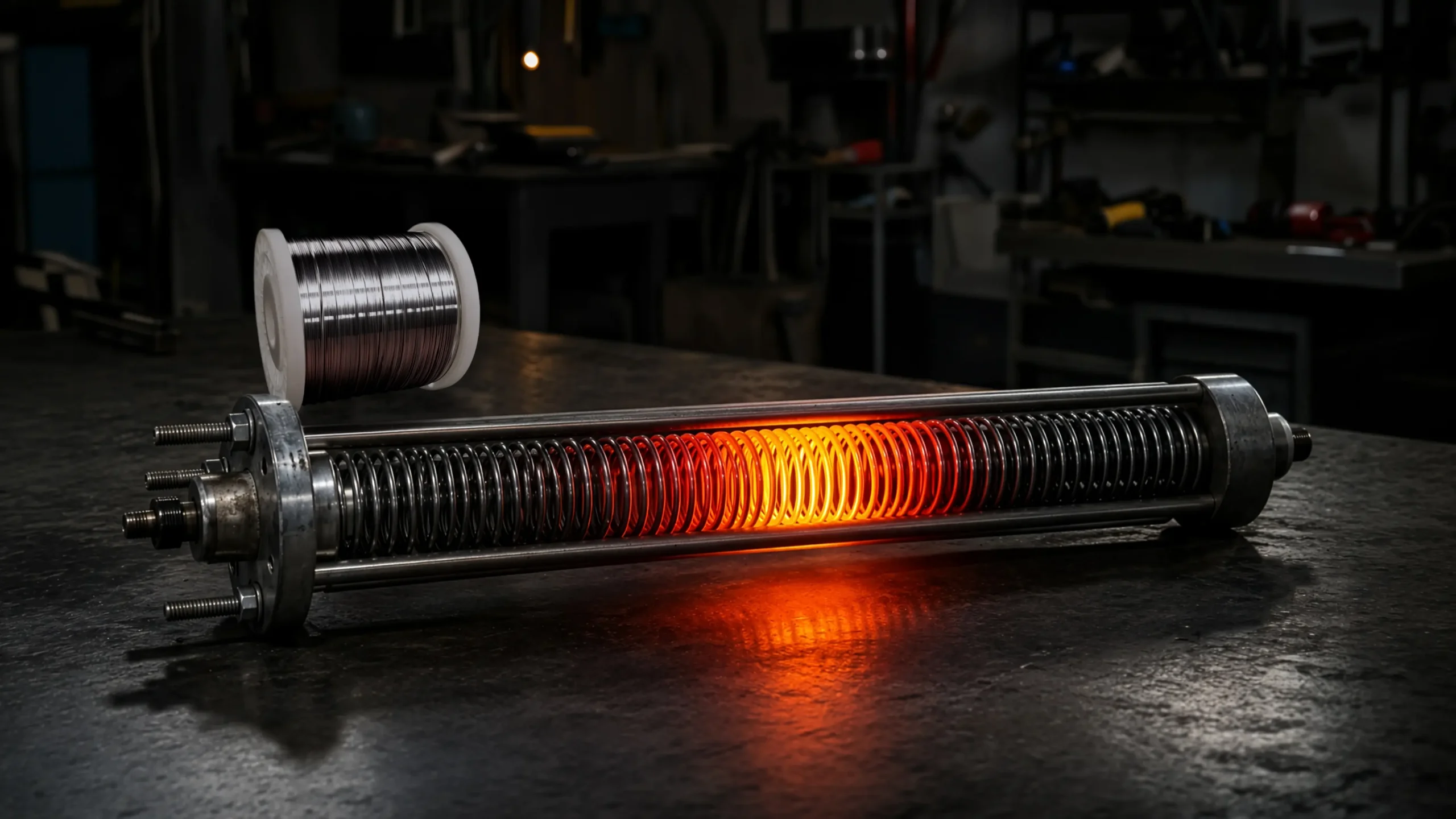


Nichrome Wire Guide: Grades, Resistance, Sizes and Applications
Nichrome wire is a nickel-chromium resistance alloy used to convert electrical energy into controlled heat. Its high electrical resistivity, oxidation resistance and structural stability make it suitable for heating elements in industrial furnaces, heaters, thermal-processing equipment and other resistance applications.
Choosing the correct nichrome wire involves more than selecting a diameter. The grade, length, cross-sectional area, resistance tolerance, element temperature, operating atmosphere and supply format all affect performance.
We supply nickel-chrome, iron-chrome-aluminium and copper-nickel resistance materials in standard and custom formats. This guide explains the main nichrome grades, how resistance is determined, which sizes and forms are available, and when an alternative heating alloy may be more suitable.
What Is Nichrome Wire and Why Is It Used?
Nichrome is the commonly used name for a family of nickel-chromium and nickel-chromium-iron resistance alloys. It is not one single grade.
When electrical current passes through a resistance material, electrical energy is converted into heat. Nichrome is useful for this purpose because it combines relatively high electrical resistivity with good resistance to oxidation and useful mechanical stability at elevated temperatures.
When heated in air, nickel-chromium alloys form a chromium-rich oxide layer on the surface. This layer helps slow further oxidation, although actual element life still depends on factors such as temperature, cycling, contamination, atmosphere, diameter, surface condition and mechanical stress.
Common uses include:
- Industrial furnace elements
- Electric heaters
- Cartridge and tubular heating elements
- Heating coils
- Hot-wire cutting equipment
- Heat-sealing systems
- Underfloor heating systems
- Wire-wound resistance components
- Laboratory and development applications
The correct alloy and dimensions must be selected for the actual operating conditions. A material’s published maximum temperature is not automatically the safe design temperature for every wire diameter, element configuration or atmosphere.
ASTM B344 covers drawn or rolled nickel-chromium and nickel-chromium-iron alloys for electrical heating elements, including nominal 80% nickel and 20% chromium compositions and lower-nickel grades containing iron.
Which Nichrome Wire Grades Are Commonly Specified?
Two nickel-chromium grades appear in the technical resistance and weight data provided by NOCKERS ENGINEERING PRODUCTS:
- Ni80Cr20
- Ni60Cr15
Although both are resistance-heating alloys, they should not be treated as interchangeable. Their alloy compositions, temperature behaviour, resistivity and cost structures differ.
Ni80Cr20 Nichrome Wire
Ni80Cr20 is commonly described as an approximately 80% nickel and 20% chromium resistance alloy. Exact composition limits depend on the applicable product specification and manufacturer.
A representative commercial Ni80Cr20 alloy has:
- Electrical resistivity of approximately 1.09 Ω mm²/m at 20°C
- Good oxidation resistance
- Good structural stability
- Good ductility after service
- Excellent weldability
- Non-magnetic behaviour
- A published maximum continuous operating temperature in air of up to 1,200°C
That 1,200°C figure is an alloy-level maximum for a representative commercial product. The allowable element temperature can be lower for small-diameter wire and will also depend on element design, support, surface loading, atmosphere and heating cycle.
Ni80Cr20 is commonly considered for industrial heating elements where stable resistance, good hot strength and reliable forming or coiling characteristics are required.
Ni60Cr15 Nichrome Wire
Ni60Cr15 is a nickel-chromium-iron resistance alloy, commonly described by a nominal composition of approximately 60% nickel and 16% chromium, with iron forming most of the balance.
Representative published data gives:
- Electrical resistivity of approximately 1.11 Ω mm²/m at 20°C
- A maximum continuous operating temperature in air of approximately 1,150°C
- Good oxidation resistance
- Good ductility and weldability
- Suitability for tubular and suspended heating elements
Ni60Cr15 may be used in electric heating appliances, air-heating equipment and other applications where its temperature and resistance characteristics fit the design.
Nichrome Grade Comparison
| Grade | General composition | Resistivity at 20°C | Representative maximum continuous temperature in air | Typical selection consideration |
|---|---|---|---|---|
| Ni80Cr20 | Nickel-chromium, approximately 80/20 | Approximately 1.09 Ω mm²/m | Up to 1,200°C | Industrial elements requiring good hot strength, oxidation resistance and stability |
| Ni60Cr15 | Nickel-chromium-iron, approximately 60/15 with iron balance | Approximately 1.11 Ω mm²/m | Up to 1,150°C | Heating systems where a lower-nickel NiCrFe grade meets the required temperature and duty |
These values are representative rather than universal. Final material selection must be based on the manufacturer’s current data sheet, required dimensions and actual service conditions.
How Do Length, Diameter and Temperature Affect Nichrome Wire Resistance?
The resistance of a uniform wire is calculated using:
R = ρL ÷ A
Where:
- R is resistance in ohms
- ρ is the material’s electrical resistivity
- L is wire length
- A is cross-sectional area
For round wire:
A = πd² ÷ 4
Where d is the wire diameter.
This means:
- A longer wire has greater resistance.
- A shorter wire has lower resistance.
- A thinner wire has greater resistance per metre.
- A thicker wire has lower resistance per metre.
- Doubling the diameter gives approximately four times the cross-sectional area, reducing resistance to roughly one quarter for the same alloy and length.
- Resistance changes as the element temperature changes.
The resistance table published by NOCKERS ENGINEERING PRODUCTS illustrates the effect of diameter on Ni80Cr20 wire at 20°C:
| Nominal diameter | Cross-sectional area | Nominal resistance per metre at 20°C |
|---|---|---|
| 0.50 mm | 0.1963 mm² | 5.551 Ω/m |
| 1.00 mm | 0.7854 mm² | 1.388 Ω/m |
| 2.00 mm | 3.142 mm² | 0.3470 Ω/m |
| 3.00 mm | 7.069 mm² | 0.1542 Ω/m |
The table also includes dimensional and conductor-resistance tolerances. These must be considered where the final element requires tightly controlled resistance.
For a simplified first calculation, the required total element resistance can be estimated from the supply voltage and target power:
R = V² ÷ P
Once the target resistance is known, the approximate wire length can be calculated using the specified resistance per metre.
This calculation is only the starting point. A heating element must also be checked for:
- Surface loading
- Element temperature
- Coil geometry
- Thermal expansion
- Support spacing
- Operating atmosphere
- Insulation
- Control method
- Electrical and mechanical safety
A wire can have the correct calculated resistance and still fail early if the surface loading, atmosphere or support arrangement is unsuitable.
What Nichrome Wire Sizes and Formats Are Available?
The published NOCKERS ENGINEERING PRODUCTS resistance and weight table provides reference values for Ni80Cr20 and Ni60Cr15 round wire across nominal diameters from 0.020 mm to 7.000 mm.
The table should not be interpreted as confirmation that every diameter is held in local stock at all times. Availability, tolerance, minimum order quantity and lead time must be confirmed for the required alloy and quantity.
Nichrome can be supplied in several forms:
Round Wire
Round wire is commonly formed into coils, spirals and other element geometries. Diameter is a primary factor in resistance per metre, mechanical strength, heat dissipation and expected element life.
Ribbon
Ribbon is a flat resistance material defined by its thickness and width. It can be selected where a flat element geometry, different surface area or specific mounting arrangement is required.
Strip
Strip is also supplied in a flat form. The distinction between ribbon and strip can vary between manufacturers and dimensional ranges, so buyers should specify the required thickness, width, resistance and tolerance rather than relying on the format name alone.
Wire, ribbon and strip can produce different resistance, surface-loading and heat-transfer characteristics even when made from the same alloy. The correct format should therefore be selected together with the element design.
We provide technical resistance and weight tables for nichrome wire, ribbon and strip, including metric and inch-size references for Ni80Cr20 ribbon.
What Is Nichrome Wire Used For?
Nichrome wire is used where electrical resistance must generate controlled heat or provide a predictable resistance value.
Industrial Furnaces and Process Heating
Industrial furnaces and thermal-processing systems use resistance elements to convert electrical energy into heat. The required grade and element design depend on furnace temperature, atmosphere, cycling frequency, support system and surface loading.
Tubular and Cartridge Heating Elements
NiCr alloys are commonly used in metal-sheathed tubular elements and cartridge heaters. These applications require careful matching between the resistance wire, insulation, sheath material, compaction process and target watt density.
Industrial and Consumer Heaters
Resistance wire is used in air heaters, water-heating systems, ovens and other equipment. The selected alloy must suit the required temperature, duty cycle, element form and surrounding materials.
Hot-Wire Cutting and Heat Sealing
Heated wire can be used to cut rigid foam or seal thermoplastic materials. The wire temperature, feed speed, element length and machine settings must be balanced. Too little heat can create a poor cut, while excessive temperature can cause stretching and shorten wire life. NOCKERS ENGINEERING PRODUCTS supplies hot-cutting wire in selected alloys for original equipment manufacturers and industrial users.
Resistance Components
Nickel-chromium and copper-nickel alloys may be used in resistance components, but the correct material depends on the required resistance, temperature coefficient, operating temperature and stability. Wire intended for precision resistance units should not automatically be treated as heating-element wire. ASTM B267, for example, covers controlled-resistance wire and ribbon for wire-wound resistance units but specifically distinguishes these products from electrical heating elements.
Research, Development and Trial Production
We can support research and development programmes with selected nickel-chrome and copper-nickel wires in trial and production quantities. For selected products, resistance tolerances down to approximately ±1% may be available, subject to alloy, diameter, quantity and manufacturing capability. We can also assist with difficult-to-find alloy and gauge combinations.
Thermocouple wire is also available through our wider range, but it performs a different function. Thermocouple wire measures temperature through a thermoelectric voltage, while nichrome wire is generally selected to provide electrical resistance or generate heat.
Nichrome Wire vs Iron-Chrome-Aluminium Wire
Iron-chrome-aluminium, commonly abbreviated as FeCrAl, is an alternative resistance-heating alloy family. It is not a grade of nichrome.
The two alloy families have different performance characteristics:
| Selection factor | Ni80Cr20 nichrome | Representative FeCrAl alloy |
|---|---|---|
| Alloy family | Nickel-chromium | Iron-chromium-aluminium |
| Representative resistivity at 20°C | Approximately 1.09 Ω mm²/m | Approximately 1.45 Ω mm²/m |
| Representative maximum continuous temperature in air | Up to 1,200°C | Up to 1,400°C |
| Protective surface oxide | Primarily chromium oxide | Primarily aluminium oxide |
| Behaviour after long service | Generally retains better ductility | Can become more brittle after prolonged high-temperature use |
| High-temperature mechanical behaviour | Generally offers stronger hot and creep performance | Higher room-temperature yield strength can support form stability during coiling |
| Sulphur exposure | More sensitive to sulphur-bearing atmospheres | Often performs better in oxidising sulphur-bearing conditions, but reducing sulphurous atmospheres remain harmful |
| Magnetic behaviour | Ni80Cr20 is non-magnetic | FeCrAl is magnetic below approximately 600°C |
| Cost and density | Nickel content can increase cost and material density | Lower density and no high nickel content can offer weight and cost advantages |
Note: The FeCrAl figures shown are representative of the alloy family and should not be treated as universal values for every grade. Exact resistivity, temperature capability and mechanical behaviour vary according to the specific FeCrAl grade, dimensions and operating conditions. Confirm the required grade and rating with our technical team before finalising a design.
The listed temperatures are representative maximum alloy temperatures in air, not guaranteed design temperatures for every element. Allowable wire temperature varies with diameter and operating conditions. For example, published guidance gives lower maximum temperatures for thin wire than for wire above 3 mm diameter.
Nichrome may be preferred where:
- Good ductility after service is important
- Strong hot or creep performance is required
- The element requires reliable forming or welding
- A non-magnetic resistance alloy is preferred
- Heat-sealing surface behaviour is important
FeCrAl may be preferred where:
- A higher maximum element temperature is required
- Higher electrical resistivity is beneficial
- Lower density is advantageous
- Strong oxidation resistance is required
- The atmosphere contains oxidising sulphur compounds
- The design can accommodate greater brittleness after service
Neither material is universally better. The correct selection depends on element geometry, temperature, atmosphere, cycling, mechanical support and total operating cost.
What Should Be Included in a Nichrome Wire Enquiry?
A complete enquiry allows us to assess the requirement and source the correct material more accurately.
Where possible, provide:
- Required alloy or grade, such as Ni80Cr20 or Ni60Cr15
- Wire, ribbon or strip format
- Diameter, or thickness and width
- Target resistance per metre or total element resistance
- Required resistance tolerance
- Supply voltage and target power
- Normal and maximum element temperatures
- Furnace or surrounding operating temperature
- Operating atmosphere and possible contaminants
- Heating cycle or duty cycle
- Coil or element geometry
- Required quantity and ordering frequency
- Preferred spool, coil or packaging format
- Required material certificates and traceability
- Drawing, sample or existing specification
It is important to distinguish between the element temperature and the temperature of the furnace, process or surrounding air. The resistance element can operate significantly hotter than the environment it is heating.
Where the final grade or size is not known, provide the application, electrical requirements and service conditions. Our technical team can then help clarify the specification before a quotation is prepared.
Explore our resistance and heating wire range for the materials, technical tables and custom-sourcing options available from NOCKERS ENGINEERING PRODUCTS.
Frequently Asked Questions
What is nichrome wire made from?
Nichrome wire is made from nickel and chromium, sometimes with iron and smaller controlled additions. Ni80Cr20 is commonly described as an approximately 80% nickel and 20% chromium alloy, while Ni60Cr15 contains less nickel and chromium, with iron forming much of the balance.
How hot can nichrome wire operate?
There is no single temperature limit for every nichrome wire. A representative Ni80Cr20 alloy may have a published maximum continuous temperature in air of up to 1,200°C, but the allowable temperature can be lower for thin wire or demanding atmospheres. Element design, surface loading, cycling and support must also be considered.
How do I calculate the resistance of nichrome wire?
Use R = ρL ÷ A, where resistivity is multiplied by wire length and divided by cross-sectional area. For round wire, the area is πd² ÷ 4. Use the supplier’s resistance-per-metre table and temperature correction data for the specified alloy and diameter.
Does thicker nichrome wire have more or less resistance?
Thicker nichrome wire has less resistance per metre because it has a larger cross-sectional area. For the same alloy and length, doubling the diameter reduces resistance to approximately one quarter.
Should I choose nichrome wire or FeCrAl wire?
Nichrome may be suitable where hot strength, ductility after service and reliable forming are important. FeCrAl may be preferred for higher-temperature operation, higher resistivity and lower material density. The correct choice depends on temperature, atmosphere, element design, cycling and support conditions.
Where can I source nichrome wire in South Africa?
NOCKERS ENGINEERING PRODUCTS supplies nichrome wire in South Africa, including nickel-chrome resistance wire, ribbon and strip for industrial heating, resistance, development and specialised manufacturing applications.
We can source selected standard and custom dimensions depending on the required grade, quantity, resistance specification and availability. Our technical team can also assist with material selection where the final alloy or size has not yet been confirmed.
Conclusion
Selecting nichrome wire requires the grade, resistance, dimensions, temperature, atmosphere and element design to be considered together. Choosing a material based only on its maximum temperature or diameter can result in incorrect resistance, inefficient heating or reduced element life.
At NOCKERS ENGINEERING PRODUCTS, we help engineers, manufacturers and procurement teams clarify resistance-wire specifications and source nickel-chrome, iron-chrome-aluminium and copper-nickel materials in formats suited to the application.
Send us your grade, diameter, quantity and application for a specification-based quote.