

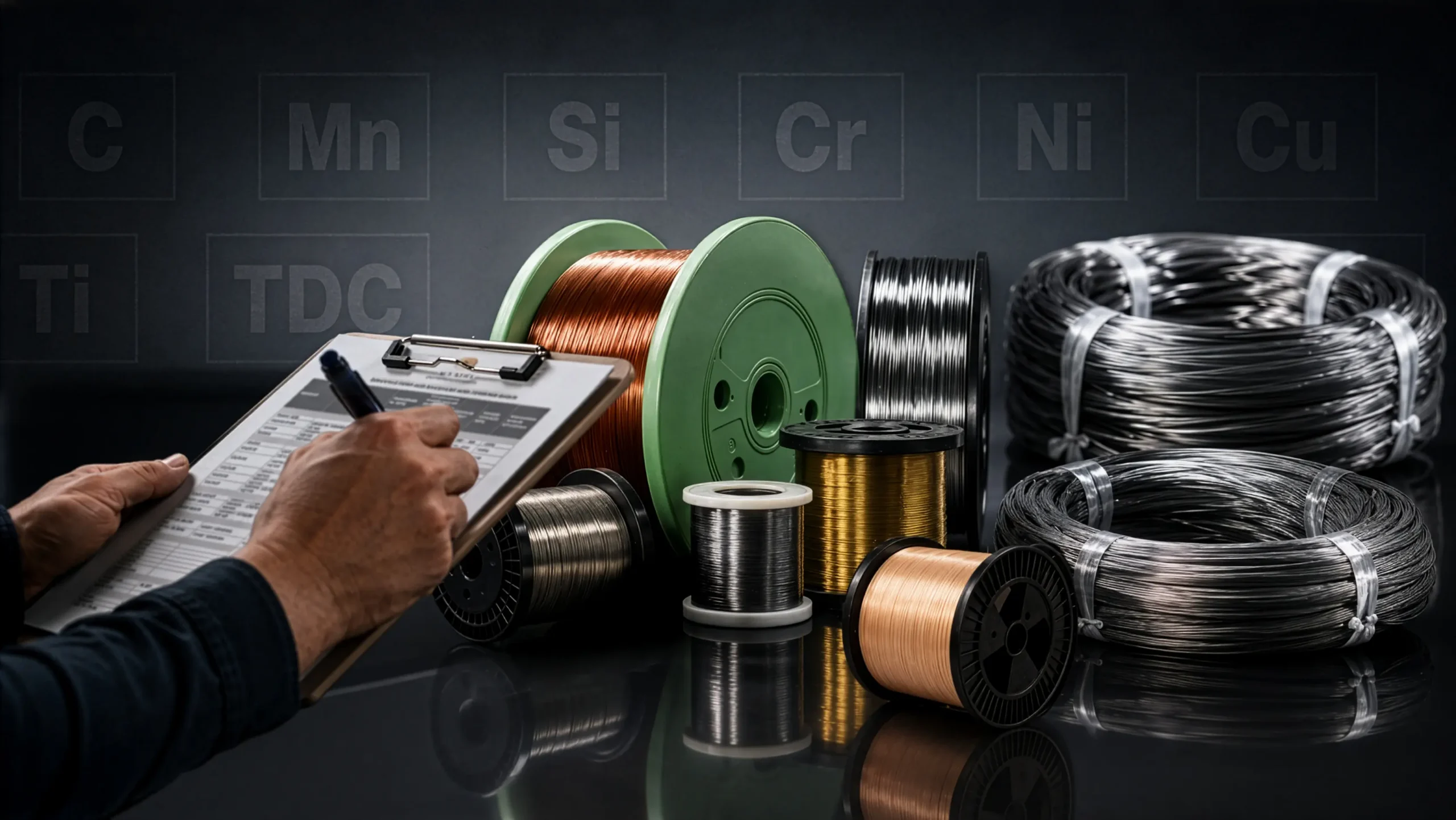


Effective industrial wire grade selection starts with the application, not simply the name of a metal. The correct wire must suit the component’s function, mechanical load, operating temperature, exposure conditions, manufacturing process and expected service life.
A wire that performs reliably in a general-purpose spring may be unsuitable for a corrosive, high-temperature or continuously cycling application. Similarly, a highly conductive material may not provide the tensile strength, formability or surface condition required by the production process.
At NOCKERS ENGINEERING PRODUCTS, we supply carbon steel, alloy steel, stainless steel, copper, aluminium, nickel alloy, welding, cold heading, resistance and heating wires for industrial applications. This guide explains how engineers, manufacturers and procurement teams can compare the main material families and develop a more complete wire specification.
Why Industrial Wire Grade Selection Matters
Industrial wire often becomes a small but critical part of a larger component or production system. It may be formed into a spring, cold headed into a fastener, used as a welding consumable, stranded into a conductor or converted into a heating element.
The wrong material, condition or supply format can contribute to:
- Premature fatigue failure
- Corrosion or surface deterioration
- Cracking during forming or heading
- Inconsistent electrical resistance
- Poor weld quality
- Excessive tooling wear
- Production interruptions
- Higher scrap and maintenance costs
A complete industrial wire specification should therefore define more than a broad description such as “stainless steel wire” or “spring wire”.
Depending on the application, it may also need to specify:
- Material grade
- Governing product standard
- Diameter and dimensional tolerance
- Tensile strength or temper
- Surface finish
- Coating or plating
- Electrical resistance or conductivity
- Delivery format
- Packaging requirements
- Certification and traceability
For example, stainless steel spring wire may be selected in AISI 302 for general applications, AISI 316 where improved corrosion resistance is required, or 17/7PH where higher strength and elevated-temperature performance are important. The correct option depends on the complete operating and manufacturing environment, not the alloy name alone.
What Should You Consider During Industrial Wire Grade Selection?
The most reliable selection process begins by defining what the finished component must do and how the wire will be processed.
| Requirement | Questions to answer | Why it matters |
| Component function | Will the wire carry load, conduct electricity, generate heat, create a weld or form a fastener? | Establishes the most appropriate material family |
| Mechanical loading | Is the load static, intermittent, impact-based or continuously cycling? | Determines strength, toughness and fatigue requirements |
| Operating environment | Will the component face moisture, salt, chemicals, gases or outdoor exposure? | Influences corrosion resistance and coating selection |
| Temperature | What are the normal and maximum operating temperatures? | Eliminates materials that may lose strength or stability |
| Electrical performance | Is conductivity, resistivity or resistance tolerance important? | Guides copper, aluminium or resistance-alloy selection |
| Manufacturing process | Will the wire be coiled, headed, woven, braided, welded, bent, plated or stranded? | Determines formability, temper, coating and surface requirements |
| Dimensions | What diameter, profile and tolerance are required? | Affects component fit, strength and production consistency |
| Supply format | Should the wire arrive on coils, spools, drums or in straight lengths? | Influences feeding, handling, waste and changeover frequency |
| Documentation | Which standards, test reports and traceability records are required? | Supports incoming inspection and quality assurance |
Providing this information at enquiry stage helps prevent a technically correct alloy from being supplied in the wrong temper, finish, tolerance or packaging format.
How Do Common Industrial Wire Materials Compare?
Carbon Steel Spring Wire for Cost-Effective Strength
Carbon steel is widely used for springs, clips and shaped wire components because it offers a practical balance of tensile strength, formability and cost.
Hard-drawn carbon steel wire may suit many standard applications. Patented-drawn and phosphated wire can offer improved surface condition and consistent forming performance, while music or piano wire represents the high-tensile end of the carbon spring-wire range.
Spring-wire specifications may reference EN 10270-1 for patented cold-drawn unalloyed spring steel wire used in static or dynamic applications. The required grade, tensile range and applicable standard edition should be confirmed against the customer’s drawing, operating conditions and manufacturing requirements before material is ordered.
We supply carbon spring wire in a range of forms and finishes, including:
- Hard-drawn wire
- Music or piano wire
- Patented-drawn wire
- Phosphate-coated wire
- Oil-tempered wire
- Zinc-plated or galvanised wire
- Copper-, tin- or nickel-coated options
Carbon steel may be suitable where high tensile strength and cost efficiency are required, provided that the environment does not demand the corrosion resistance or temperature performance of a more specialised alloy.
For grade, finish and tensile information, review our spring wire technical specifications or speak to our technical team.
Alloy Steel Wire for Repeated Dynamic Loads
Alloy steel wire is generally considered when a component will experience continuous cycling, vibration, shock loading or demanding fatigue conditions.
The addition of elements such as silicon, chromium or vanadium can improve fatigue performance, strength retention and suitability for dynamic service. These materials are commonly supplied in oil-hardened and tempered or induction-heated and tempered conditions.
Oil-hardened and tempered spring steel wire may be specified under EN 10270-2. The standard covers unalloyed and alloyed spring steel wire used primarily for components exposed to torsional loading, including compression and extension springs. Because technical drawings and existing data sheets may reference different editions, the applicable standard and edition should be confirmed during the specification review.
We typically supply alloy spring wire for applications such as:
- Automotive and industrial engine valve springs
- Heavy-duty axle springs
- Transport equipment
- Industrial machinery
- Continuously cycling mechanical components
Alloy steel is not automatically the correct choice for every spring. Its value is greatest where the load cycle, fatigue requirement or operating temperature justifies the additional material and processing cost.
Stainless Steel Wire for Corrosion Resistance
Stainless steel wire is commonly selected where moisture, humidity, mineral salts, chemicals or hygiene requirements make unprotected carbon steel unsuitable.
The grade should be matched to the severity of the application:
- AISI 302: commonly selected for general stainless spring applications
- AISI 316: often considered where improved resistance to aggressive or chloride-bearing environments is required
- 17/7PH: selected where higher strength and elevated-temperature spring performance are important
Surface condition also affects production. Bright wire may be preferred where cleanliness or appearance matters, while dull or soap-coated wire can assist forming. Nickel-coated or straightened wire may be required for particular machinery or manufacturing processes.
Stainless steel wire may be suitable for:
- Marine and coastal equipment
- Food and beverage processing machinery
- Chemical-handling systems
- Wet or humid environments
- Springs, mesh, braiding and weaving
- Formed and precision-engineered components
A stainless steel alloy should not be described as “food grade” purely on the basis of its grade name. Suitability also depends on the component design, surface finish, fabrication method, cleaning regime and applicable industry requirements.
Copper and Copper Alloy Wire for Conductivity and Formability
Pure copper wire is normally selected where electrical or thermal conductivity is the primary requirement.
We supply pure copper grades including ETP, C101, OFCu and C103. Our wider non-ferrous range also includes brass, phosphor bronze, nickel silver and other copper alloys that combine conductivity with different levels of strength, resilience, corrosion resistance and formability.
The required condition and coating must be defined carefully:
- ASTM B1 covers hard-drawn round copper wire for electrical purposes.
- ASTM B3 covers soft or annealed round bare copper wire for electrical purposes.
- ASTM B33 covers tin-coated soft or annealed copper wire for electrical purposes.
- ASTM B355 covers nickel-coated soft or annealed copper wire for electrical equipment. (ASTM Store)
Pure copper is commonly used in motors, transformers, wiring harnesses, conductors and cable manufacturing. Copper alloys may be preferred where the component also requires increased strength, spring properties, solderability or specialised environmental performance.
The final decision should consider:
- Required conductivity
- Mechanical strength
- Hard-drawn or annealed condition
- Plating or coating
- Wire diameter
- Stranding or bunching process
- Operating environment
- Required certification
For grade and coating information, review our fine copper wire technical specifications.
Aluminium Wire for Lightweight Conductivity
Aluminium wire offers lower density than copper, useful electrical conductivity, corrosion resistance and good formability.
It is used in applications including:
- Electrical cables
- Overhead conductors
- Cable screening and shielding
- Cable armouring
- Braiding
- Rivets and screws
- Woven products
- Other formed components
Aluminium wire for electrical applications may be specified against standards such as ASTM B233 for aluminium 1350 drawing stock and the applicable IEC requirements for overhead conductor wire. Project specifications and legacy drawings may reference different editions, so the required standard should always be confirmed before ordering. IEC 62641 now consolidates requirements for aluminium and aluminium-alloy wires used in concentric-lay overhead conductors. (IEC Webstore)
We can assist with specification clarification and source aluminium wire in the grade, diameter, condition and packaging format required for the application.
Our range includes mono-wire and multi-wire products supplied on:
- Coils
- Layer-wound coils
- Formers or spiders
- Plastic spools
- Metallic spools
Packaging should be selected according to the production equipment, handling requirements and expected consumption rate.
For available dimensions and supply formats, review our aluminium wire technical data.
Resistance and Heating Wire for Controlled Heat Generation
Resistance and heating wire must be selected according to electrical resistivity, required resistance, operating atmosphere, element temperature, thermal cycling and expected service life.
We supply three principal resistance-alloy families:
- Nickel-chrome
- Iron-chrome-aluminium
- Copper-nickel
Nickel-chrome alloys are widely used for stable resistance and heating applications. Iron-chrome-aluminium alloys may be considered where high-temperature oxidation resistance is important. Copper-nickel alloys are commonly used in lower-resistance and precision-resistance applications.
The required wire, ribbon or strip dimensions should be calculated together with:
- Supply voltage
- Target power
- Resistance per unit length
- Element length
- Surface loading
- Operating atmosphere
- Support method
- Thermal expansion
We can also source selected copper-nickel and nickel-chrome materials in trial or production quantities, including difficult-to-find alloy and gauge combinations. Resistance tolerances as tight as approximately ±1% may be available for selected products, subject to the alloy, diameter, quantity and manufacturing capability.
For resistance tables and alloy information, review our resistance and heating wire technical information.
Welding Wire Must Match the Process and Base Material
Welding wire selection depends on more than the wire diameter.
The specification should consider:
- Base material
- MIG, TIG, submerged-arc or flux-cored process
- Joint design
- Welding position
- Shielding gas or method
- Required weld-metal properties
- Corrosion and temperature exposure
- Applicable welding procedure
- Packaging and feed system
MIG wire supports continuous feeding and higher-production welding, while TIG filler is commonly selected where control, cleanliness and joint quality are central requirements. Flux-cored products may be appropriate where higher deposition rates or specific fabrication conditions justify their use.
We supply stainless steel, aluminium alloy, copper alloy, nickel alloy, MIG, TIG, submerged-arc and flux-cored welding materials. We can also source non-standard grades for specialised industrial applications.
Final selection should always be checked against the base material, approved welding procedure and required weld performance.
Cold Heading Wire Must Suit Severe Forming
Cold Heading Quality wire is converted into fasteners and components through substantial plastic deformation.
Successful cold heading depends on:
- Chemical composition
- Heat-treatment condition
- Diameter and dimensional tolerance
- Surface cleanliness
- Coating consistency
- Ductility and formability
- Tooling and heading sequence
- Secondary forming requirements
A wire grade with adequate final strength may still perform poorly during production if its surface, coating or heat-treatment condition is unsuitable.
We supply Cold Heading Quality stainless steel wire produced under controlled chemical, mechanical and surface conditions. Available solutions include coatings designed to improve headability, support consistent forming and extend tool life.
The intended component and severity of deformation should therefore be discussed during specification review.
Industrial Wire Grade Comparison Guide
| Wire family | Main selection property | Typical applications |
| Hard-drawn carbon steel | Cost-effective strength and formability | General springs, clips and wire forms |
| Music or piano wire | High tensile performance | Precision and high-stress springs |
| Oil-tempered alloy steel | Fatigue resistance under dynamic loading | Valve, axle and heavy-duty springs |
| AISI 302 stainless steel | General corrosion resistance | Springs and industrial formed components |
| AISI 316 stainless steel | Improved resistance in more aggressive environments | Marine, chemical and moisture-exposed equipment |
| 17/7PH stainless steel | Strength and elevated-temperature performance | High-performance springs and technical components |
| Pure copper wire | High electrical and thermal conductivity | Motors, transformers, conductors and cables |
| Copper alloy wire | Conductivity with additional mechanical properties | Contacts, spring components and specialised equipment |
| Aluminium wire | Low mass and useful conductivity | Cables, conductors, braiding and formed parts |
| Nickel-chrome wire | Stable electrical resistance at elevated temperature | Heating elements and industrial heaters |
| Iron-chrome-aluminium wire | High-temperature oxidation resistance | Furnaces and industrial heating systems |
| Cold Heading Quality wire | Formability and surface consistency | Bolts, screws, rivets and fasteners |
| Welding wire | Compatibility with process and base material | Fabrication, manufacturing and repair |
Why Standards, Certificates and Traceability Matter
A grade name alone does not confirm that wire will meet the application requirements.
A complete purchase specification may need to state:
- Material and grade
- Product standard and applicable edition
- Diameter and tolerance
- Tensile strength or temper
- Surface condition
- Coating or plating
- Electrical resistance or conductivity
- Packaging and winding format
- Required test documentation
ISO 9001 relates to a manufacturer’s quality-management system. It does not, by itself, confirm that a particular wire grade is suitable for a specific application. Product suitability must still be verified against the required material grade, product standard, dimensions, mechanical or electrical properties and test documentation. (ISO)
At NOCKERS ENGINEERING PRODUCTS, we source through established manufacturing partners and provide material certificates and mill test reports as standard, with manufacturers’ ISO 9001 documentation available where applicable.
Full traceability may also be provided where required, helping procurement and quality teams confirm the product source and verify that the supplied material matches the order specification.
Common Mistakes When Selecting Industrial Wire
Choosing on Price Alone
The lowest initial purchase price may create higher total costs through reduced service life, poor forming, increased scrap, repeated maintenance or unplanned downtime.
Specifying Only the Material Family
Descriptions such as “stainless”, “copper” or “spring steel” are too broad for a reliable production order. The grade, dimensions, condition, finish and governing standard should also be defined.
Ignoring the Operating Environment
Moisture, chlorides, chemicals, gases and temperature can change which material is suitable, even where two options provide similar mechanical strength.
Overlooking the Manufacturing Process
A wire may provide the required finished properties but still perform poorly during coiling, heading, weaving, welding or machine feeding if its surface, temper or packaging is unsuitable.
Using an Existing Standard Without Confirming the Edition
Technical standards are periodically revised or consolidated. Drawings, data sheets and customer specifications may refer to different editions, so the exact requirement should be confirmed by the responsible technical authority before material is ordered.
Treating Packaging as an Afterthought
Coils, spools, drums and straight lengths interact differently with production equipment.
The correct pack weight, winding method and protective wrapping can:
- Reduce handling
- Limit material damage
- Improve machine feeding
- Reduce waste
- Minimise production changeovers
Review our industrial wire packaging options when planning the supply format for your operation.
What Information Should Be Included in a Wire Enquiry?
A detailed enquiry helps us evaluate the application and prepare an accurate recommendation and quotation.
Where possible, provide:
- Component or end application
- Existing material grade or standard
- Drawing, photograph or sample
- Diameter, profile and tolerance
- Tensile strength, temper or resistance requirement
- Surface finish or coating
- Operating temperature
- Environmental exposure
- Quantity and expected ordering frequency
- Preferred coil, spool, drum or straight-length format
- Required certificates and traceability
- Delivery location and target date
Where the final grade is unknown, begin with the application, operating conditions and production process.
We work with engineers, manufacturers, OEMs and procurement teams to clarify specifications and source both specialised small quantities and larger industrial volumes.
Frequently Asked Questions
What is an industrial wire grade?
An industrial wire grade identifies a material with a defined chemical composition and expected properties. A complete order may also need to specify the product standard, diameter, tensile condition, temper, finish, coating and delivery format.
Which wire grade is best for a corrosive environment?
There is no single grade for every corrosive environment. AISI 302 may suit general moisture exposure, while AISI 316 may be considered for more aggressive marine, chloride-bearing or chemical conditions. The environment, temperature, mechanical stress and fabrication process must still be reviewed.
What is the difference between carbon steel and alloy spring wire?
Carbon steel spring wire provides cost-effective strength for many general applications. Alloy spring wire includes elements such as silicon, chromium or vanadium and is generally selected where fatigue life, repeated dynamic loading or strength retention place greater demands on the component.
Which wire is used for industrial heating elements?
Nickel-chrome and iron-chrome-aluminium alloys are commonly used for industrial heating elements. Copper-nickel alloys may be used for lower-resistance or precision-resistance applications. Selection depends on the required resistance, temperature, atmosphere and element design.
Does ISO 9001 confirm that a wire is suitable for my application?
No. ISO 9001 relates to the manufacturer’s quality-management system. The wire must still comply with the required material grade, product standard, dimensions, mechanical or electrical properties and test documentation for the application.
Conclusion
The correct industrial wire grade is the one that satisfies the complete application, not simply the material with the highest tensile strength, greatest corrosion resistance or lowest purchase price.
Mechanical loading, fatigue, temperature, corrosion, conductivity, manufacturing process, surface finish, dimensional tolerance, packaging and certification should be evaluated together. A complete specification improves production consistency, reduces procurement risk and helps the finished component perform as intended.
Need help selecting the correct grade, finish and supply format? Contact our technical team to discuss your application and request a tailored quotation.